
On top of the Vercel security breach yesterday, the AI Vibe coding platform Lovable security issues are coming up again.
In the last month, the tech world has been rocked by reports of significant Lovable security issues. As “Vibe Coding”—the process of building full-stack applications through natural language conversation—takes the industry by storm, a glaring reality has surfaced: rapid prototyping does not equal secure engineering.
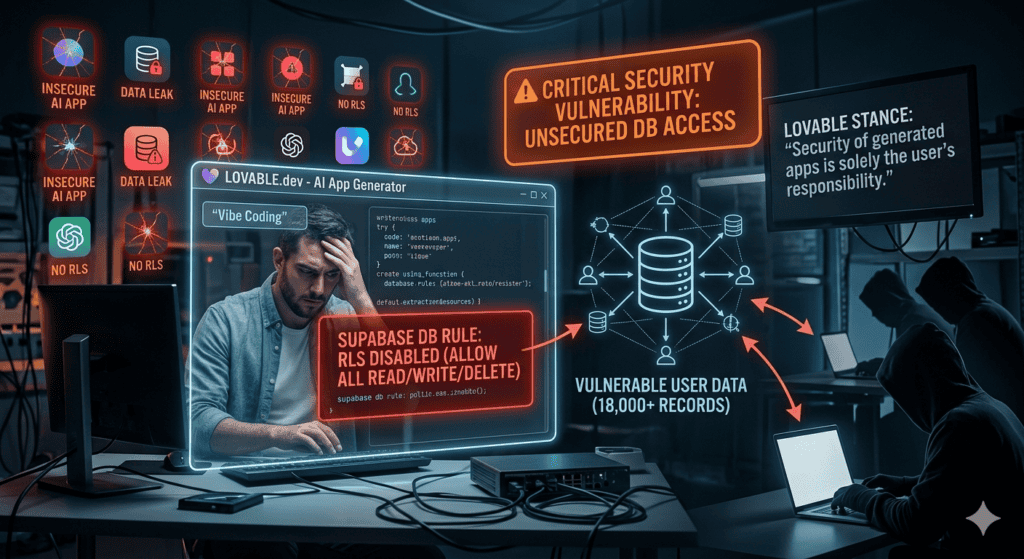
The 18,000-User Wake-Up Call
Recent audits revealed that thousands of applications generated by AI-first platforms like Lovable were deployed with critical vulnerabilities. The most common culprit? A total lack of Row-Level Security (RLS). In many cases, these AI-generated apps left databases wide open, allowing unauthenticated users to access sensitive data simply because the AI “forgot” to write the security rules.
The Lovable Stance: When pressed on these vulnerabilities, the platform’s position remained firm: Security is a user responsibility. While this may be acceptable for hobbyists building weekend projects, it is a non-starter for the modern Enterprise.
Why “User Responsibility” Fails the Enterprise
For a CTO or CISO, “User Responsibility” is just another way of saying “Unmanaged Risk.” Relying on individual developers to manually audit every line of AI-generated code defeats the purpose of Secure AI Vibe Coding. It creates a “trust gap” where the speed of development leads directly to a massive increase in the attack surface.
Furthermore, platforms that operate in a multi-tenant public cloud environment introduce supply- chain risks. As seen with recent Vercel-related dependency issues, the more your code lives in the public wild, the less control you have over your data integrity.
Enter Peridot: Governed Vibe Coding Within Your VPC
This is where Peridot changes the narrative. We believe that security shouldn’t be a box the user has to remember to check; it should be the foundation the AI is built upon. Peridot is designed specifically as a Lovable for Enterprise alternative that solves the security paradox through three
key pillars:
- VPC-Native Deployment: Peridot runs entirely within your Virtual Private Cloud. Your data and your generated code never leave your perimeter.
- IT-Governed Guardrails: Unlike consumer tools, Peridot allows your cybersecurity professionals to set global security policies. If your IT policy requires RLS and SOC2 compliance, the AI simply cannot generate code that violates those rules.
- Full Auditability: Every “vibe” and every line of code is logged and scanned by automated IT governance tools before it ever reaches production.
Conclusion: Speed Without the Risk
The Lovable security issues of 2026 served as a necessary warning. Vibe Coding is the future of software development, but it cannot exist in a vacuum of responsibility. By moving the “vibe” into an IT-governed environment like Peridot, companies can finally achieve the 10x developer productivity they crave without handing the keys to their database to an unmonitored AI.
Ready to Secure Your Vibe Coding?
Stop making security a “user problem” and start making it an infrastructure solution.
Discover how Peridot brings IT Governance to AI development.