
Inside most large enterprises right now, something subtle but profound has broken.
It does not look like a crisis. It looks like productivity. Teams are shipping faster than ever. Tools appear overnight. AI systems are built in days, sometimes hours. Internal dashboards multiply. Knowledge bases expand. Work accelerates. From the outside, this looks like progress.
From the inside, it feels like something else entirely.
The System That Used to Govern Everything
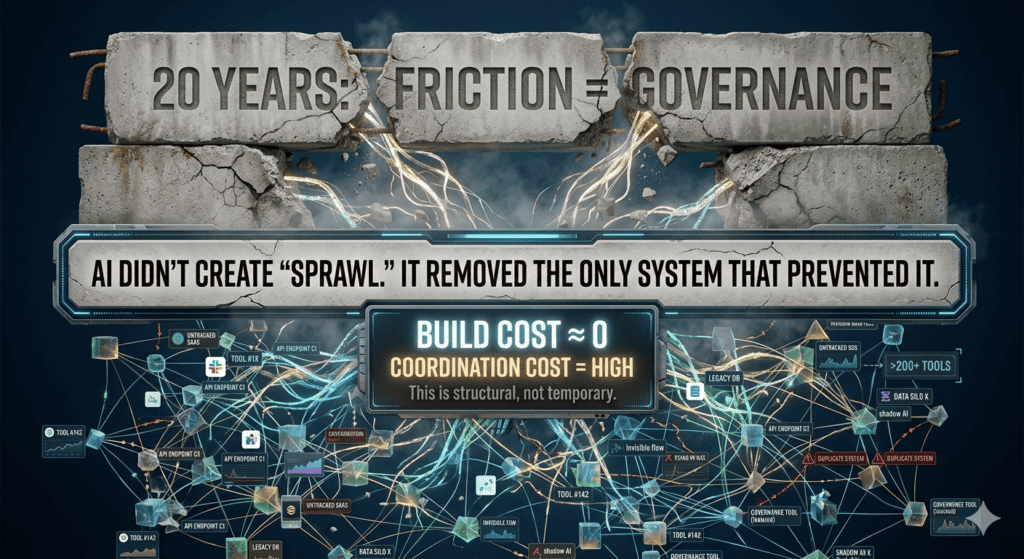
For the past two decades, enterprises had an invisible governance system. It wasn’t a policy. It wasn’t a committee. It wasn’t a framework. It was friction.
- Building internal tools took weeks or months
- Maintenance required ongoing engineering investment
- Deployment required coordination across teams
That cost structure did something important:
It forced teams to look around before building.
- “Does this already exist?”
- “Who owns this?”
- “Can we reuse something?”
And if they didn’t ask those questions, the system corrected them later. Duplicate tools didn’t survive. They were too expensive to maintain. Redundant systems died quietly—not because someone enforced governance, but because the economics enforced it automatically. Friction was the immune system.
AI Removed the Immune System
AI changes that equation completely.
- A tool can be built in a day
- Maintenance is minimal
- Deployment is trivial
- Distribution is invisible
Creation cost has collapsed. But something critical did not collapse with it:
The cost of understanding what already exists. That cost is still high. In many organizations, it is higher than ever. The result is a structural imbalance:
| Function | Cost (Before AI) | Cost (After AI) |
|---|---|---|
| Build | High | Near zero |
| Govern | Implicit | Explicit + High |
| Discover | Moderate | Extremely high |
This gap is where AI sprawl emerges—not as a failure of discipline, but as a failure of system design.
This Is Not About Duplication
The common narrative is that enterprises are suffering from duplication. Multiple tools doing the same thing. Teams unaware of each other. Redundant systems everywhere. That is true—but it is not the root problem. Duplication is a symptom. The real issue is this:
The organization no longer has a coordination mechanism.
When friction disappears, coordination does not automatically replace it.
And without coordination:
- Teams build in isolation
- Data flows without visibility
- Ownership becomes ambiguous
- Systems proliferate faster than they can be understood
The Rise of “Ghost Systems”
There is a second-order effect that makes this worse.
AI systems do not just create tools. They create derived artifacts.
- Summaries of documents
- Extracted insights
- Embedded knowledge bases
- Generated code and workflows
These outputs are stored elsewhere. Indexed by other systems. Accessed independently of their source. When the original data changes—or is restricted—the derived artifacts do not update. They persist. They propagate. They are copied again. You end up with:
Information that cannot be fully traced, revoked, or even located.
Not because the organization is careless. Because the system was not designed for this behavior.
Governance Is Becoming Recursive
Enterprises are responding in the only way they know how:
They are building governance tools.
- Discovery platforms
- Inventory dashboards
- Risk scoring systems
- Monitoring layers
These tools ingest data. They create their own artifacts. They operate independently across teams. They are often unaware of each other. Which means:
Governance itself is now part of the sprawl.
The system is trying to map itself while expanding.
The KPI Problem
Compounding this is a familiar enterprise dynamic:
Adoption is measured. Coordination is not.
- AI usage targets are set
- Tool adoption is incentivized
- Velocity is rewarded
Meanwhile:
- Redundancy is not penalized
- Visibility is incomplete
- Ownership is unclear
When metrics drive behavior, and the metrics favor creation, the outcome is predictable. The system scales in the direction it is measured.
This Is Structural, Not Temporary
It is tempting to treat this as a temporary phase. Early adoption. Growing pains. A mess that will stabilize over time. It won’t.
Because the underlying conditions are not changing:
- AI will continue to reduce build cost
- Tool creation will continue to accelerate
- Data movement will continue to expand
- Embedded AI will continue to proliferate
Without a new coordination mechanism, the gap will widen.
What Needs to Change
The solution is not more dashboards. It is not more reporting. It is not better documentation. Those operate after the system has already expanded.
What is required is a shift in where governance lives.
From:
- Post-hoc visibility
- Reactive auditing
- External oversight
To:
- Pre-execution control
- Embedded policy enforcement
- System-level constraints on creation and data flow
In other words:
Governance must move from observation to control.
The New Reality
Enterprises are entering a new phase:
- Where building is trivial
- Where duplication is inevitable
- Where data propagates autonomously
- Where governance cannot rely on friction
The organizations that adapt will not be the ones that see everything. They will be the ones that control what can happen in the first place.
Final Thought
This is not AI sprawl. It is the collapse of the system that used to prevent it. And until that system is replaced with something explicit, intentional, and embedded—
Every organization will look like this.
Read more on Github or Talk to us at Peridot on how we solve for this.