
When I ran Microsoft ventures we would give the same advice to every non-technical founder: find a technical co-founder, or raise enough money to hire one. That advice made sense in 2015. In 2026, it is just gatekeeping dressed up as wisdom.
The tools to ship a real, profitable product without a developer exist. The question is no longer “can I build this?” but “which platform is the right foundation?” Nobody gives you a straight answer because most are either selling a platform or afraid to commit to a recommendation.
This post commits. We’ve evaluated ten platforms—not just by their feature sets, but by their honest weaknesses that marketing teams won’t tell you. Whether you are following a weekend project guide or building a long-term SaaS, here is the buying guide for the modern non-technical founder.
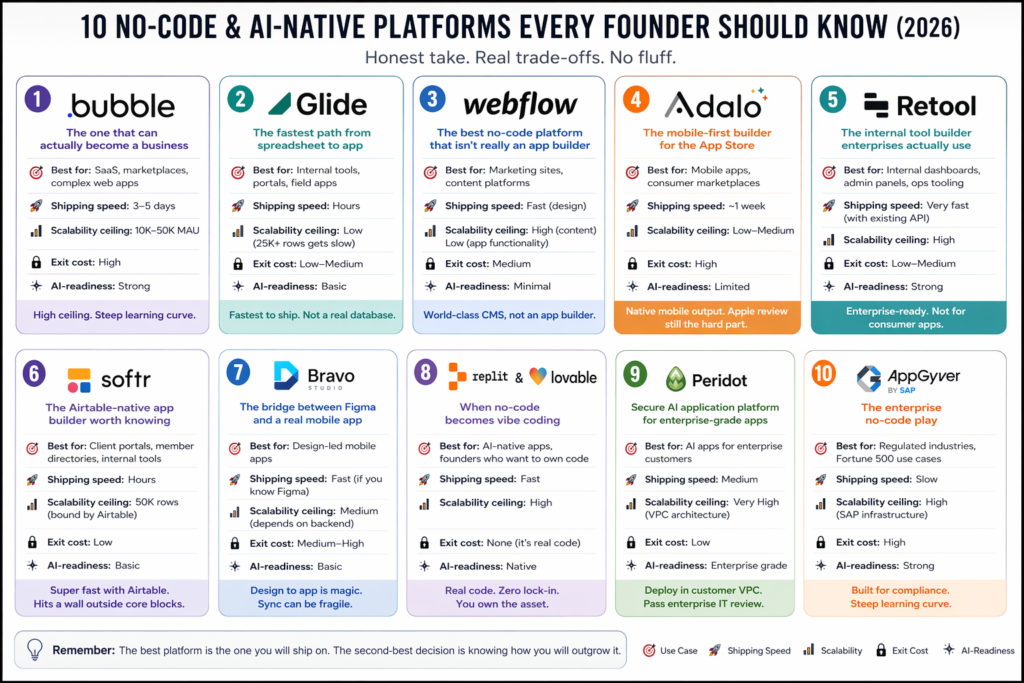
How to read this list — the criteria that actually matter
Before the list, you need an evaluation rubric. We aren’t looking at “drag-and-drop ease”; we are looking at business viability. We evaluated these no coding platforms against four specific criteria. If you have other criteria, that’s great.
- Shipping speed: How many days (not features) does it take to get from a blank canvas to a live URL?
- Scalability ceiling: At what specific number—users, records, or sessions—does the platform start to buckle?
- Exit cost: If you outgrow the tool or they triple their prices, how much will it cost to migrate? (Spoiler: No platform tells you this honestly).
- AI-readiness: How easily can you integrate LLM APIs, and more importantly, how secure is that data?
A platform that looks great in a demo but breaks at 500 real users is not on this list.
Bubble — the one that can actually become a business
Verdict: The highest ceiling of any no-code platform. If you are building a SaaS, a marketplace, or anything with complex relational data, Bubble is the answer.
- Best for: SaaS products, marketplaces, apps with deep user roles.
- Shipping speed: Slow start. Expect 3–5 days for the logic to “click,” then development becomes rapid.
- Scalability ceiling: 10K–50K Monthly Active Users (MAU). Beyond that, you’ll need a dedicated developer for performance tuning.
- Exit cost: High. Bubble’s logic is proprietary. Leaving means rebuilding the backend from scratch.
- AI-readiness: Strong API connector for OpenAI/Anthropic, though credential management happens platform-side.
- The thing they won’t tell you: The learning curve is steep. You won’t ship a complex app in 48 hours unless you’ve used the tool before. It requires a week of “logic training” first.
Glide — the fastest path from spreadsheet to app
Verdict: If your data already lives in Google Sheets or Airtable, Glide turns it into a real app in hours. It is the king of internal tools.
- Best for: Internal tools, simple customer portals, field team apps.
- Shipping speed: Fastest on the list. Hours, not days.
- Scalability ceiling: Low. Glide is a presentation layer. Once your spreadsheet hits 25k+ rows, the app will feel sluggish.
- Exit cost: Low-medium. Your data is already in your spreadsheet. Rebuilding the UI elsewhere is manual but not a catastrophe.
- AI-readiness: Surface-level AI components. Not for building complex AI products.
- The thing they won’t tell you: Glide is not a database. The moment you need complex relational data across ten different object types, you are fighting the tool.
Webflow — the best no-code platform that isn’t really an app builder
Verdict: The gold standard for content-heavy sites. It is a world-class CMS, but it is not an application builder.
- Best for: Marketing sites, content platforms, design-heavy landing pages.
- Shipping speed: Fast for design; slow for app logic.
- Scalability ceiling: Very high for content; low for app functionality.
- Exit cost: Medium. It exports HTML/CSS, but CMS migration is manual.
- AI-readiness: Minimal native AI. Most founders bolt on Zapier or Make, which creates a security risk for enterprise API credentials.
- The thing they won’t tell you: Every Webflow “app” eventually requires three other subscriptions (Memberstack, Xano, etc.) to function.
Adalo — the mobile-first builder with a real learning payoff
Verdict: The best native mobile app builder for founders who need to be in the App Store without a developer.
- Best for: Mobile-first consumer apps, simple community marketplaces.
- Shipping speed: Medium. About a week to ship.
- Scalability ceiling: Low-medium. Database performance degrades above a few thousand records.
- Exit cost: High. The backend is proprietary.
- AI-readiness: Limited. External API calls are possible but clunky compared to Bubble.
- The thing they won’t tell you: Adalo doesn’t bypass Apple’s review. You still need to plan for a two-week approval cycle with Apple, which is often harder than building the app itself. As we noted in our No-Code Mobile App Development Platform guide, passing Guideline 4.2 is the real challenge.
Retool — the internal tool builder enterprises actually use
Verdict: If you already have a database and need a dashboard for your team, Retool is in a category of its own.
- Best for: Internal dashboards, admin panels, ops tooling.
- Shipping speed: Very fast—if you have an existing API. Zero speed if you don’t.
- Scalability ceiling: High. It’s built for enterprise internal use.
- AI-readiness: Strong. Native LLM integrations and a better security posture for enterprise data.
- The thing they won’t tell you: Retool is not for consumer apps. Don’t try to build the next Instagram here.
Softr — the Airtable-native app builder worth knowing
Verdict: If Airtable is your database, Softr is the fastest way to turn it into a client portal.
- Best for: Client portals, member directories, internal tools on Airtable.
- Shipping speed: Fastest for its use case. Hours.
- Scalability ceiling: Bound by Airtable’s 50k-row limits.
- Exit cost: Low. Data stays in Airtable.
- The thing they won’t tell you: It’s a specialized tool. The moment you step outside its core blocks, you hit a wall you can’t climb.
Bravo Studio — the bridge between Figma and a real mobile app
Verdict: The only tool that starts with a Figma design and turns it into a functional native app.
- Best for: Design-led founders where visual experience is the differentiator.
- Shipping speed: Fast if you are a Figma pro.
- Scalability ceiling: Medium. It relies on your external backend API.
- The thing they won’t tell you: The Figma-to-app pipeline is brittle. Small design changes in Figma can break the sync unexpectedly.
Replit and Lovable — when no-code becomes vibe coding
This is the 2026 frontier. These are platforms where you describe what you want in plain language, and the AI writes real code.
Verdict: Replit Agent and Lovable represent the blur between no coding platforms and AI-assisted development. You get an app that you own, with zero platform lock-in.
- Best for: Founders who want no-code speed but need to own the code.
- Shipping speed: Fast for well-defined apps.
- Exit cost: Zero. It’s real code. You can host it anywhere.
- AI-readiness: Native. You aren’t “bolting on” AI; you’re building with it.
- The thing they won’t tell you: Vibe-coded apps still need a security architecture. When your app starts calling LLM APIs with real user data, standard deployment isn’t enough. Founders graduating to this level often use Peridot—a secure AI application platform that provides VPC deployment and credential isolation to make your “vibe-coded” app enterprise-approvable.
Additionally, these AI-native products hit a support gap quickly. HelpViber fills this by providing support infrastructure specifically for AI products that don’t fit the legacy Zendesk mold.
AppGyver / SAP Build — the enterprise no-code play
Verdict: The only platform on this list built for enterprise compliance from day one.
- Best for: Regulated industries or selling to Fortune 500s.
- Shipping speed: Slow. Enterprise grade means enterprise complexity.
- Scalability ceiling: High. It runs on SAP’s infrastructure.
- The thing they won’t tell you: Startup founders usually find the learning curve too steep and give up.
The platform you should use — a decision matrix
To make this useful, you need to choose. Our No-Code App Builder Definitive Guide goes deeper, but here is the 2026 “Buying Matrix”:
| Use case | Platform | Why |
|---|---|---|
| SaaS product with complex logic | Bubble | Highest ceiling, most flexibility |
| Internal tool on existing data | Retool or Glide | Speed to ship, data stays yours |
| Mobile consumer app | Adalo | Best native mobile output |
| AI-native product you own | Replit or Lovable | Real code, zero lock-in |
| AI app for enterprise customers | Vibe coding + Peridot | Security that passes IT review |
The one question every founder forgets to ask
Before you pick, ask: “What happens if this platform triples its prices or shuts down?”
If you build on Bubble or Adalo, the answer is a total rebuild. If you build on Glide or Softr, you can pivot reasonably well. If you build on Replit or Lovable, you own the asset.
For the non-technical founder, the goal is to ship. But as we discussed in No-Code vs. Traditional Development, speed today should not create a catastrophic debt tomorrow. The best no coding platform is the one you actually ship on, but the second-best decision is knowing exactly how you will eventually outgrow it.
If your growth plan involves selling to enterprise customers, the deployment architecture is what closes the deal. Platforms like Peridot allow you to deploy these applications within a customer’s own infrastructure (VPC), solving the “vendor risk” question before your first sales call.
The Notion doc has waited long enough. Pick your tool and start the weekend build.