
TL;DR
AI tool sprawl refers to the uncontrolled proliferation of AI tools across an organization, where multiple teams adopt different tools without centralized visibility, governance, or coordination. Most enterprises underestimate the number of tools in use by 2–5x. Identifying and measuring sprawl requires continuous tracking of tools, users, and usage patterns across the organization.
In our analysis of 429 enterprises and 23 interviews, we found that most organizations lack visibility into AI usage and data flow.

What is AI Tool Sprawl?
AI tool sprawl is the uncontrolled expansion of AI tools across an organization. It occurs when different teams adopt tools independently, often without approval, coordination, or awareness of what others are using.
This is not just a tooling problem. It is a visibility and governance problem.
AI tool sprawl typically includes:
- Multiple tools solving similar problems across teams
- Overlapping functionality and redundant subscriptions
- Unapproved or “shadow” AI tools used outside governance
- AI features embedded within existing SaaS platforms
It is not just about the number of tools. It is about the lack of coordination and visibility across how those tools are used.
Why AI Tool Sprawl is a Problem
Sprawl creates complexity, and complexity creates risk.
As organizations adopt AI rapidly, they lose the ability to track where tools are being used, what data is flowing through them, and how decisions are being made.
Key issues include:
- No clear inventory of tools in use
- Increased likelihood of shadow AI usage
- Inconsistent policies across teams
- Difficulty tracking sensitive data exposure
As sprawl increases, control decreases. Most organizations only recognize the problem after risk or inefficiency becomes visible.
Why AI Tool Sprawl is Different from SaaS Sprawl
At first glance, AI tool sprawl looks similar to SaaS sprawl. In practice, it is more difficult to manage.
AI adoption is faster, more decentralized, and often invisible.
Unlike traditional SaaS tools, AI tools:
- Are easy to adopt without procurement or IT involvement
- Often run through personal accounts or browser-based access
- Are embedded into existing software rather than standalone
- Process sensitive data in ways that are difficult to track
This makes AI tool sprawl both harder to detect and higher risk than traditional SaaS sprawl.
Types of AI Tool Sprawl
AI tool sprawl is not a single issue. It typically appears in multiple forms across an organization.
Tool sprawl occurs when multiple tools are used for similar functions, leading to redundancy and inefficiency.
Data sprawl occurs when data flows across multiple AI tools without visibility, increasing exposure risk.
Access sprawl occurs when employees use AI tools without centralized control or approval.
Workflow sprawl occurs when AI is embedded into different processes across teams, making it difficult to understand how work is actually being done.
Understanding these categories helps identify where risk is concentrated.
Signs Your Organization Has AI Tool Sprawl
Most organizations already have some level of sprawl.
Common indicators include:
- Different teams using different AI tools for the same task
- Employees using personal or free AI tools
- No centralized list of approved AI tools
- Inability to answer “How many AI tools are we using?”
If any of these are true, sprawl is already present.
How to Identify AI Tool Sprawl
The first step is not control. It is visibility.
AI tool sprawl can be identified through a combination of discovery, analysis, and monitoring.
Key Signals of AI Tool Sprawl
| Signal | What it means |
|---|---|
| Multiple AI tools per team | Lack of standardization |
| No central inventory | No visibility |
| Sensitive data in prompts | Security risk |
| Duplicate workflows | Inefficiency |
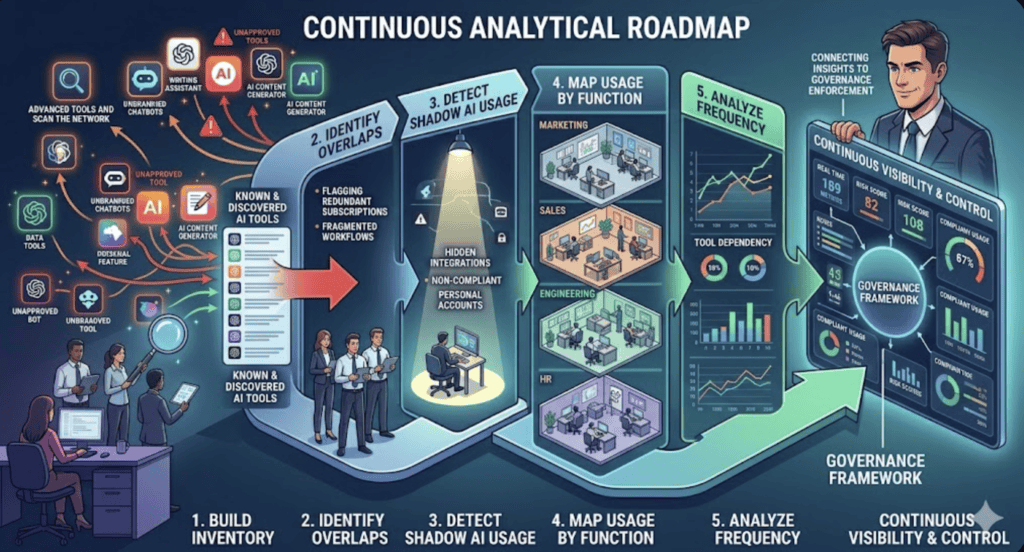
Step-by-Step Approach
1. Build a complete inventory of AI tools
Start by identifying all tools in use, including:
- Approved tools
- Known tools used by teams
- Tools discovered through network or SaaS analysis
Most organizations underestimate this number significantly.
2. Identify overlapping AI tools
Look for:
- Multiple AI tools serving the same function
- Redundant subscriptions
- Fragmented workflows across teams
This highlights inefficiency and cost duplication.
3. Detect shadow AI usage
A large portion of sprawl is driven by tools outside formal approval.
Identify:
- Tools not on approved lists
- Personal account usage
- Untracked integrations
Shadow AI is often the largest blind spot.
4. Map usage across teams
- Marketing
- Sales
- Engineering
- HR
This reveals where duplication, fragmentation, and risk are concentrated.
5. Analyze usage frequency
Not all tools matter equally.
Track:
- Active vs inactive tools
- Frequency of usage
- Dependency on specific tools
This helps prioritize action.
How to Measure AI Tool Sprawl
You need metrics, not just observations. The goal is to quantify sprawl so it can be managed over time.
Key Metrics
1. Number of AI tools in use
Total tools across the organization, as well as per department.
2. Tool overlap ratio
The number of tools solving similar problems and the degree of redundancy.
3. Shadow AI percentage
The percentage of tools not formally approved or governed.
4. Usage concentration
Which teams drive the most usage and where risk is concentrated.
5. Change over time
New tools added per month and the growth rate of AI adoption.
Tracking these metrics continuously provides a baseline for governance.
AI Usage and Sprawl Statistics
- 75% of knowledge workers use AI tools regularly (Microsoft)
- 78% bring their own AI tools into work environments (Cisco)
- Most organizations underestimate tool usage by 2–5x
AI tool sprawl is not an edge case. It is the default outcome of AI adoption.
What We See in Real Enterprise Environments
Across organizations, a consistent pattern emerges.
AI tool counts grow rapidly without oversight. Teams optimize locally, choosing tools that work for them without considering broader impact. As a result, sprawl increases faster than governance.
The most common pattern is simple:
Organizations discover sprawl only after risk or inefficiency becomes visible.
How AI Tool Sprawl Connects to Visibility and Governance
AI tool sprawl is not the root problem. It is the result of deeper issues.
It is driven by:
- Lack of visibility
- Lack of tracking
- Lack of governance
To control sprawl, organizations need:
- Discovery of tools across environments
- Continuous tracking of usage and data flow
- Structured governance frameworks
Without visibility, governance is not possible.
How Peridot Helps
AI tool sprawl cannot be managed manually.
Peridot provides continuous visibility into AI tools, usage patterns, and data exposure. It helps organizations identify sprawl, reduce redundancy, and enforce governance across teams.
Instead of reacting to sprawl after it creates risk, organizations can proactively control it.
FAQ
What is AI tool sprawl?
AI tool sprawl is the uncontrolled proliferation of AI tools across an organization without centralized visibility or governance.
Is AI tool sprawl a security risk?
Yes. It increases the likelihood of sensitive data exposure and unmanaged AI usage.
How do organizations detect AI tool sprawl?
Through discovery, monitoring, and analysis of tools, users, and data flows across systems.
How is AI tool sprawl different from shadow AI?
Shadow AI is a subset of sprawl. Sprawl includes all AI tool usage, while shadow AI refers specifically to unapproved tools.