
TL;DR
Most enterprises underestimate how many AI tools employees are using. Discovering them requires a combination of network monitoring, SaaS audits, employee surveys, and policy enforcement. Without visibility, organizations risk data leakage, compliance violations, and uncontrolled AI sprawl.
Introduction
If your CEO asked today, “How many AI tools are we using across the company?”—most teams couldn’t answer.
AI adoption didn’t go through IT. It went through curiosity.
Marketing teams using ChatGPT. Engineers experimenting with copilots. HR testing AI screening tools. All without centralized tracking.
This creates a blind spot:
You can’t govern what you can’t see.
Before governance, compliance, or security—you need visibility.
Why AI Tool Discovery Matters in Enterprises
AI tools are not just productivity software. They are data processors.
That means:
- Sensitive company data may be exposed
- Customer data may leave your systems
- Compliance boundaries may be crossed unknowingly
Common risks include:
- Uploading proprietary data into public AI models
- Unauthorized tools storing internal conversations
- Lack of audit trails for AI-generated outputs
Without discovery, these risks remain invisible.
Step-by-Step: How to Discover AI Tools Across Your Organization
1. Analyze Network and SaaS Usage
Start with what you can observe directly:
- Review network logs for known AI domains (OpenAI, Anthropic, etc.)
- Use SaaS management tools to identify shadow applications
- Analyze browser activity if available
This gives you a baseline of known usage patterns.
2. Audit Existing SaaS Stack
Many AI tools are already embedded in tools you’ve approved.
Check:
- CRM (AI assistants, enrichment tools)
- Marketing platforms (AI copy, automation tools)
- Engineering tools (code generation, copilots)
AI is often hidden inside existing subscriptions.
3. Conduct Internal Surveys
This sounds basic. It works.
Ask:
- “What AI tools do you use weekly?”
- “What tasks do you use AI for?”
- “What data do you input into these tools?”
You’ll uncover tools that never show up in logs.
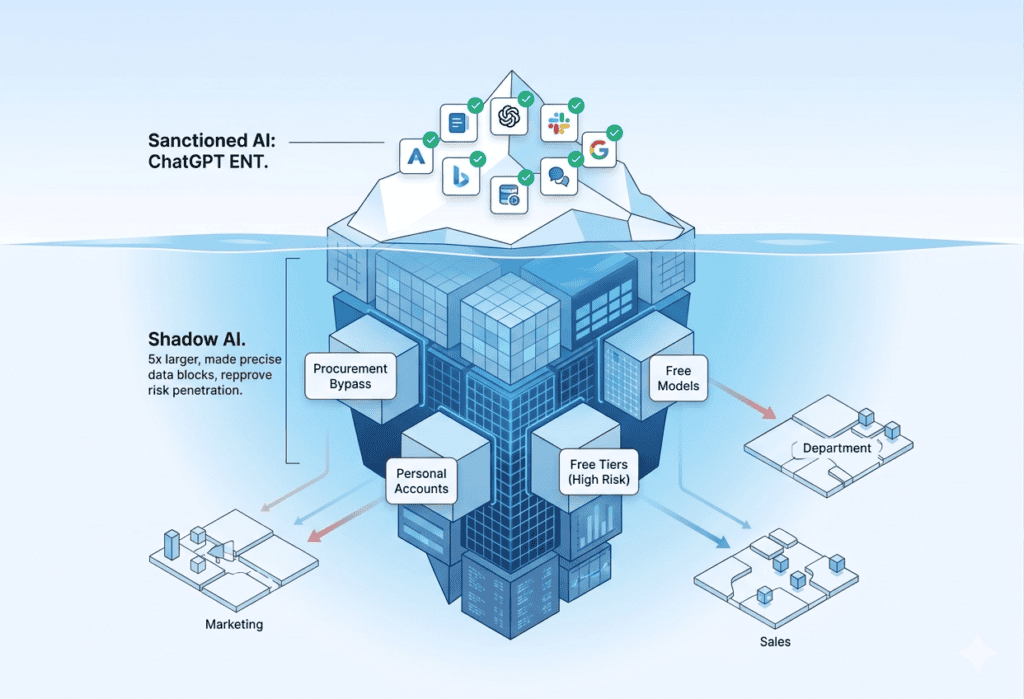
4. Identify Shadow AI Usage
Shadow AI = tools used without approval.
Look for:
- Teams using free versions of AI tools
- Personal accounts instead of company accounts
- Tools bypassing procurement
This is where most risk lives.
(We break this down further in our guide on detecting shadow AI.)
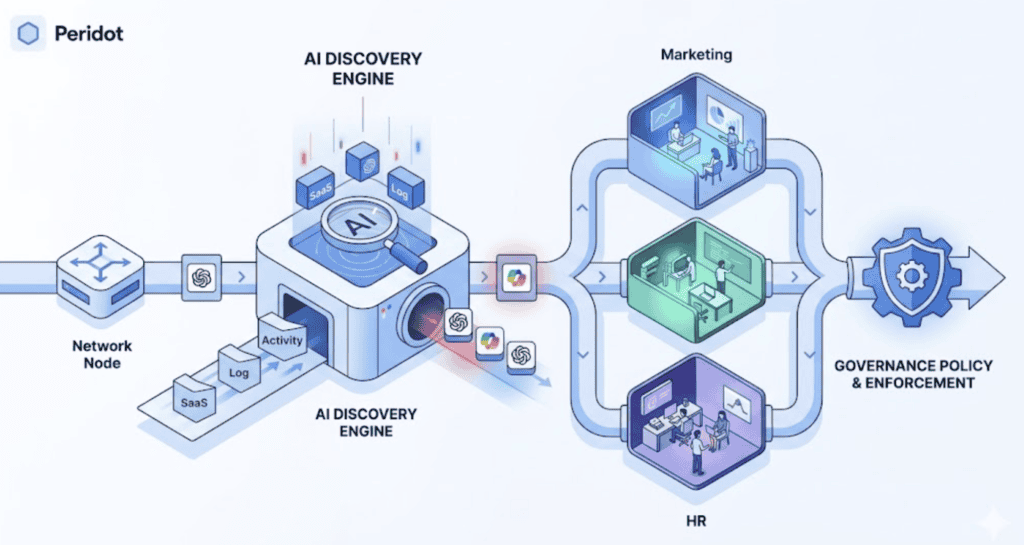
5. Map Usage by Department
Once identified, categorize:
- Marketing → content generation, research
- Sales → email drafting, prospecting
- Engineering → code generation, debugging
- HR → resume screening, candidate analysis
This helps you understand:
- where adoption is highest
- where risk is concentrated
AI Usage & Risk Statistics
- 75% of knowledge workers use AI tools at work (Microsoft Work Trend Index)
- 78% of AI users bring their own tools (BYOAI) (Cisco)
- Only ~30% of organizations have formal AI governance policies (McKinsey)
The gap between usage and oversight is growing.
What We See in Real Enterprise Environments
Across organizations, patterns repeat:
- AI adoption starts bottom-up, not top-down
- IT is often weeks or months behind actual usage
- Most companies underestimate usage by 2–5x
The biggest mistake?
Thinking AI adoption is controlled because a few tools were approved.
In reality:
Approval ≠ visibility
What Happens After Discovery
Once you know what’s being used, the next steps are:
- Establish governance policies
- Define approved vs unapproved tools
- Monitor ongoing usage
- Reduce risk exposure
Discovery is not the end—it’s the starting point.
Once discovered, the next step is auditing usage across teams – See Guide
FAQ
How do enterprises track AI tool usage?
Enterprises track AI tools usage through a mix of network monitoring, SaaS audits, and internal reporting.
What is shadow AI?
AI tools used without formal approval or oversight by IT or security teams.
This often leads to shadow AI usage.
Why is AI visibility important?
Without visibility, organizations cannot manage risk, enforce policies, or ensure compliance.
Can AI tools expose sensitive data?
Yes. Many tools process and store input data, which may include proprietary or personal information.
Tools like Peridot are designed to give enterprises real-time visibility into AI usage across teams—without relying on manual audits or surveys.
Instead of guessing, organizations can continuously monitor AI activity, identify risks, and enforce policies from a single system.
We did a detailed analysis of Shadow AI tracking, usage across 423 companies. We interviewed 23 people as well. The insights we gathered are a big part of the product.
Pingback: What is Shadow AI and How to Detect It in Your Organization - Peridot Blog
Pingback: How to Track AI Tool Usage Across Employees and Departments - Peridot Blog
Pingback: We Analyzed Enterprise AI Usage: What 429 Respondents Revealed - Peridot Blog
Pingback: AI Tool Sprawl: How to Identify and Measure It in Your Organization - Peridot Blog