
The agency quote that comes back at $85,000 is not a scam. It reflects the actual cost of building an enterprise mobile application the traditional way. What it doesn’t reflect is that traditional development is no longer the only way — and for most founders at the idea or early-validation stage, it isn’t even the right way.
This guide maps seven paths to a deployed mobile app. For each one: the real cost, the real timeline, the right use case, and the one thing that goes wrong most often.
Why most mobile app cost guides are wrong
They’re written by the people selling the most expensive path.
Agency blogs discuss custom development costs because agencies do custom development. No-code platform blogs highlight no-code success stories because platforms sell subscriptions. Neither source has a financial incentive to tell you the full picture.
The full picture: in 2026, seven meaningfully different paths exist to get a mobile application from idea to the App Store. They span a cost range from nearly zero to several hundred thousand dollars, and a timeline range from a weekend to a year. Matching your project to the right path is worth more than any specific technical decision you’ll make during the build.
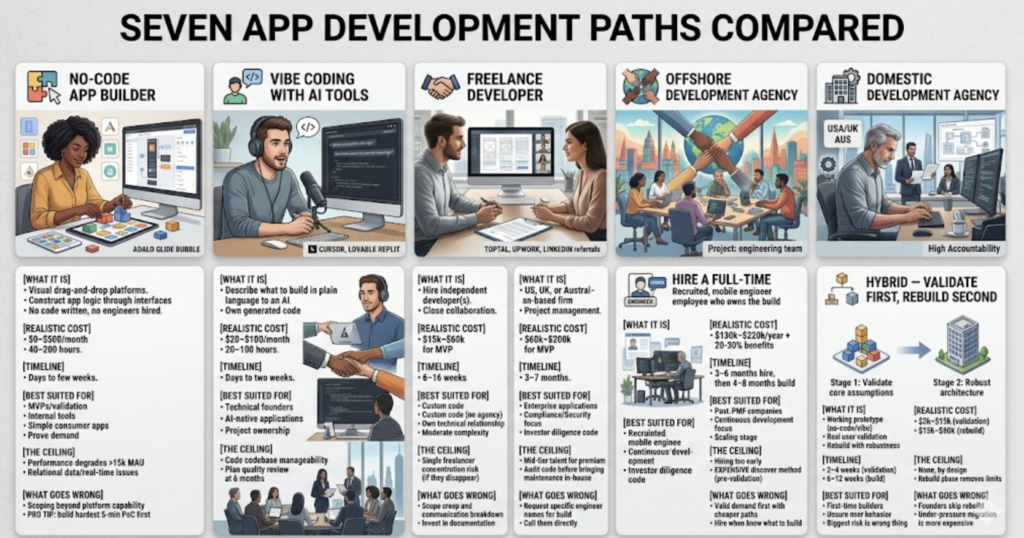
The 7 paths
Path 1: No-code app builder
What it is: Visual drag-and-drop platforms — Adalo, Glide, Bubble — where you construct app logic through interfaces. No code written, no engineers hired.
Realistic cost: $0–$500/month in platform fees. Time investment: 40–200 hours depending on complexity.
Realistic timeline: Days to a few weeks for a working product.
Best suited for:
- MVPs and validation projects
- Internal tools with limited user bases
- Simple consumer apps with standard patterns (booking, directory, marketplace basics)
- Founders who need to prove demand before investing in real development
What goes wrong most often: Founders scope beyond the platform’s capability without realizing it until they’re 80% through the build. Always verify that your most complex feature is possible on the platform before starting. Build a five-minute proof of concept for the hardest part first.
The ceiling: Most no-code platforms degrade in performance above 5,000–15,000 monthly active users. Complex relational data, real-time features, and custom algorithms hit walls earlier.
Path 2: Vibe coding with AI tools
What it is: Describing what you want to build in plain language to an AI development tool — Cursor, Lovable, Replit Agent, Claude Code — and iterating on the generated code until the app works. The output is real source code you own.
Realistic cost: $20–$100/month in tooling. Time investment: 20–100 hours for a functional MVP.
Realistic timeline: Days to two weeks for a focused build.
Best suited for:
- Founders with enough technical literacy to understand code and catch problems
- AI-native applications that call LLM APIs
- Projects where you need to own the code and control the infrastructure
- Anyone who has validated a concept with no-code and is ready to rebuild it properly
What goes wrong most often: Vibe-coded applications often have security gaps that aren’t visible in the code but matter in production. API keys hardcoded in the frontend, missing rate limiting, insufficient input validation. A deliberate security pass — either self-directed or with a tool like Peridot for AI-specific security — is not optional if the app handles real user data.
The ceiling: The ceiling is your ability to manage and extend the codebase as it grows. Vibe coding produces working code; it doesn’t always produce maintainable architecture. For applications that need to scale to large teams or complex features, plan a code quality review at the six-month mark.
Path 3: Freelance developer
What it is: Hiring one or more independent developers — found through Toptal, Upwork, LinkedIn, or referral — to build the application for you.
Realistic cost: $15,000–$60,000 for an MVP depending on developer location, experience level, and project scope.
Realistic timeline: 6–16 weeks from contract to App Store submission.
Best suited for:
- Projects that need custom code but can’t support a full-time engineering hire
- Founders who want to own the technical relationship and be closely involved
- Applications with moderate complexity that don’t justify an agency engagement
What goes wrong most often: Misaligned expectations about what “MVP” means. Define the feature list in writing before any money changes hands. Specify what “done” looks like for every feature. Wireframes are not sufficient — you need written acceptance criteria for each screen and flow.
The ceiling: A single freelancer is a concentration risk. If they disappear, get sick, or take a better-paying project, your build stalls. For anything mission-critical, either hire two developers or maintain enough code familiarity to brief a replacement quickly.
Path 4: Offshore development agency
What it is: Contracting a development firm based in Eastern Europe, South Asia, or Latin America to build the application. Typically involves a discovery phase, fixed or time-and-materials contract, and project management from the agency side.
Realistic cost: $20,000–$80,000 for an MVP. Hourly rates range from $25–$65 depending on location and firm quality.
Realistic timeline: 3–6 months from signed contract to App Store submission.
Best suited for:
- Projects with defined scope and no ambiguity about requirements
- Founders who have built products before and know how to spec them
- Teams that want to move faster than a single freelancer allows
What goes wrong most often: Scope creep and communication breakdown. Offshore agencies work best with extremely detailed specifications. Any ambiguity in the brief becomes an argument at billing time. Invest two to three weeks in thorough documentation before the build starts — it saves months of dispute later.
The ceiling: Code quality varies significantly across agencies. Before signing, ask for two client references you can call directly, request a sample of recent code for review, and ask specifically about their mobile deployment and App Store submission experience. Many agencies build well but have limited experience navigating Apple’s review process.
Path 5: Domestic development agency
What it is: A US, UK, or Australian-based development firm handling the full build. Higher cost, higher accountability, typically stronger project management.
Realistic cost: $60,000–$200,000 for an MVP. Hourly rates range from $100–$250.
Realistic timeline: 3–7 months from kickoff to launch.
Best suited for:
- Enterprise applications with compliance requirements
- Projects where the security architecture needs to be designed by experienced engineers
- Founders who are raising money and need code quality that will survive investor due diligence
What goes wrong most often: Paying premium rates for mid-tier talent. The agency name is not a proxy for the quality of the specific team assigned to your project. Before signing, get the names of the engineers who will build your product and have them on a call. If the agency won’t commit specific people to your project, that is a signal.
The ceiling: Agency code is often optimized for delivery speed, not long-term maintainability. The same engineers who built your product won’t be there when you need to extend it. Budget for a code quality audit before you bring maintenance in-house.
Path 6: Hire a full-time engineer
What it is: Recruiting and hiring a mobile engineer (or two) as a full-time employee who owns the build.
Realistic cost: $130,000–$220,000/year in salary and benefits for a senior mobile engineer in the US. Add 20–30% for employer taxes and benefits. Junior engineers cost less but move slower and require more oversight.
Realistic timeline: 3–6 months to hire (in current market conditions), then 4–8 months to build.
Best suited for:
- Post-product-market-fit companies building their second or third major feature set
- Applications that will require continuous development for two or more years
- Founders who have already validated demand and are scaling
What goes wrong most often: Hiring too early. A full-time engineer at a pre-validation startup is the most expensive way to discover that users don’t want the product. Validate with no-code or vibe coding first. Hire engineers when you know what you’re building and why.
The ceiling: One engineer is still a concentration risk. Two engineers often produce less than double the output of one due to coordination costs. Plan for this in your timeline.
Path 7: Hybrid — validate first, rebuild second
What it is: Building a working prototype on no-code or with vibe coding tools, getting it in front of real users, validating core assumptions, then rebuilding with more robust architecture once you know what actually matters.
Realistic cost: $2,000–$15,000 for validation phase, $15,000–$60,000 for the production rebuild.
Realistic timeline: 2–4 weeks for validation, 6–12 weeks for the production build.
Best suited for:
- First-time app builders
- Anyone unsure whether users will actually use the core feature the way they imagine
- Projects where the biggest risk is building the wrong thing, not building it wrong
What goes wrong most often: Founders skip the rebuild because “it’s working fine.” The no-code prototype becomes the production application. This is fine until you hit the scalability ceiling or need a feature the platform can’t support — and then migration under pressure is significantly more expensive than planned migration.
The ceiling: None, by design. The rebuild phase removes the ceiling.
The cost comparison table
| Path | Build cost | Monthly cost | Year 1 total | Own the code? |
|---|---|---|---|---|
| No-code | $0–$2K | $50–$500 | $1K–$8K | No |
| Vibe coding | $500–$2K | $50–$200 | $2K–$5K | Yes |
| Freelancer | $15K–$60K | $500–$2K | $20K–$85K | Yes |
| Offshore agency | $20K–$80K | $1K–$5K | $30K–$110K | Yes |
| Domestic agency | $60K–$200K | $2K–$10K | $85K–$320K | Yes |
| Full-time hire | $40K–$80K | $12K–$22K | $185K–$345K | Yes |
| Hybrid | $5K–$20K | $500–$3K | $20K–$55K | Partial → Yes |
The decision framework
Answer these four questions. The answers map directly to a path.
1. Do you have validated evidence that users want this?
- No → no-code or vibe coding for validation first
- Yes → any path is appropriate
2. Does your application require custom logic, real-time features, or enterprise security from day one?
- No → no-code or vibe coding
- Yes → vibe coding with security architecture, freelancer, or agency
3. Is your primary constraint time or money?
- Time → domestic agency or full-time hire
- Money → vibe coding, offshore agency, or hybrid
4. Will this application call LLM APIs and handle enterprise data?
- Yes → the security architecture needs deliberate design regardless of which path you choose. No-code platforms, most freelancers, and many agencies don’t default to enterprise-grade AI security. If this is your use case, the security layer is a first-class requirement, not a post-launch concern.
What most founders get wrong
They treat the development path as a permanent commitment. It isn’t.
The right path for validation is almost never the right path for scale. The right path for an internal tool is almost never the right path for a consumer product. The frameworks that let you ship fastest in week one often create the most friction in month twelve.
Build for the stage you’re in. Plan for the stage you’re heading toward. And don’t spend $80,000 proving that nobody wants the thing before you spend $2,000 proving the same thing faster.
Also read: How to Develop an Enterprise Mobile Application in 2026 with Vibe Coding: The Honest Guide
Up next in this series
- Part 3: The 8 Best Mobile App Development Platforms for Non-Engineers
- Part 4: How to Choose an App Development Platform: The Decision Framework
- Part 5: Mobile App Software Development — In-House vs No-Code vs AI-Assisted
- Part 6: Best Mobile App Creation Software for Solo Founders
- Part 7: Mobile App Building Software — What the Benchmarks Show
Pingback: How to Choose an Enterprise App Development Platform: The Decision Framework - Peridot Blog
Pingback: How to Develop an Enterprise Mobile Application in 2026 with Vibe Coding: The Honest Guide - Peridot Blog
Pingback: The 8 Best Mobile App Development Platforms for Non-Engineers - Peridot Blog