
Enterprise AI is beginning to follow a very familiar pattern.
First comes experimentation. Then adoption. Then fragmentation. Then operational chaos. Then eventually, somebody builds the management layer. That exact cycle happened with cloud infrastructure. It happened with SaaS. It happened with mobile devices. It happened with APIs. And now it is happening again with AI agents Most enterprises today are somewhere between the experimentation and fragmentation phases.
A sales team builds an outbound prospecting agent. Marketing deploys a campaign assistant. Support launches a ticket triage workflow. HR experiments with recruiting copilots. Finance automates reporting summaries. Operations teams stitch together workflows across Slack, Notion, Salesforce, Jira, ServiceNow, and internal systems using increasingly powerful AI tooling.
At first, this feels like progress.
Teams move faster. Bottlenecks disappear. Internal software requests that used to take six months now get solved in a few days. Employees suddenly feel leverage they have never had before. Executives love the demos.
Then the second-order effects start showing up.
Nobody knows how many agents exist inside the company. Nobody knows which models they use. Nobody knows what permissions they have. Nobody knows which systems they can write to. Nobody knows where sensitive data is flowing. Nobody knows which agents are actually producing ROI. Nobody knows which workflows are now partially autonomous. This is the beginning of what will become one of the defining enterprise technology problems of the next decade:
AI Sprawl.
The irony is that AI sprawl is not a sign that AI failed. It is a sign that AI became useful faster than governance could keep up. That distinction matters.
Most discussions around enterprise AI still focus on model intelligence. Which model is smartest. Which benchmark is best. Which startup has the best reasoning capabilities. Which AI assistant produces the best outputs. But intelligence is not actually the hardest enterprise problem. Operations are.
Enterprises do not run on intelligence alone. They run on systems. Systems require permissions, observability, lifecycle management, rollback controls, monitoring, auditability, ownership, and governance. This is where much of the current AI market narrative breaks down. Most companies are still thinking about AI agents as prompts. But agents are not prompts. Agents are operational systems. A prompt is disposable. A production agent is infrastructure.
The moment an agent gains access to enterprise systems, customer data, workflows, approvals, or operational processes, it stops being a novelty interface and starts becoming part of the company’s execution layer.
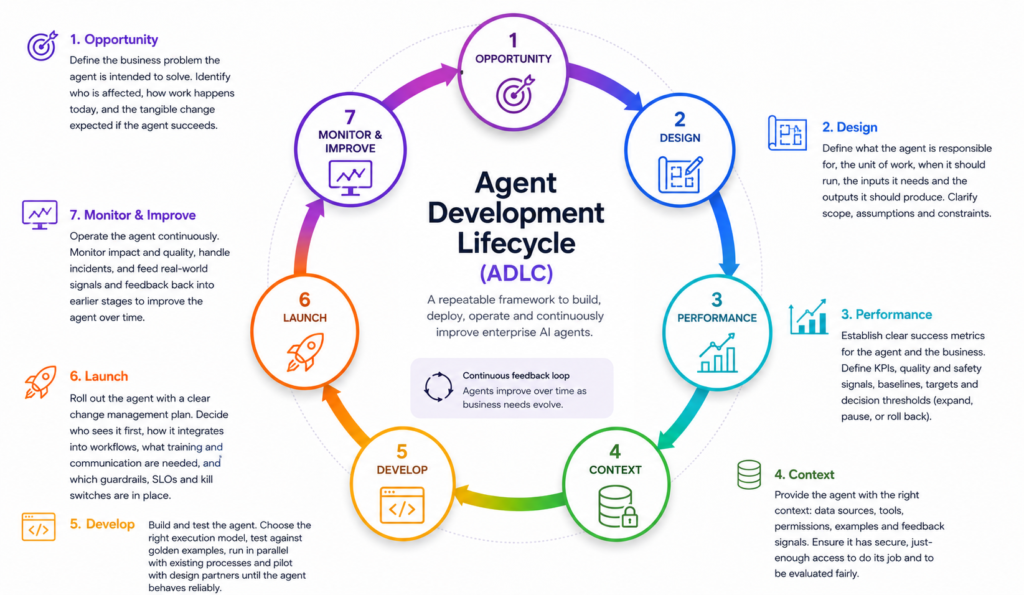
That transition is already underway.
One of the clearest signals came recently from our customer who termed it the “Agent Development Lifecycle” or ADLC. The framework itself is relatively straightforward: define the business opportunity, design the agent, establish performance metrics, provide enterprise context, develop, launch, monitor, and continuously improve.
The interesting part is what it reveals about where enterprise AI is heading. The industry is slowly rebuilding the software development lifecycle for AI agents. That is a major shift. For years, AI discussions revolved around experimentation. Build a chatbot. Add a copilot. Automate a workflow. Fine-tune a model. Improve prompts. Now enterprises are realizing the harder problem begins after deployment.
- Who governs these agents?
- Who monitors them?
- How are they evaluated?
- What systems can they access?
- How do you audit their actions?
- How do you manage risk?
- How do you prevent duplication?
- How do you sunset old workflows?
- How do you track business outcomes across hundreds or thousands of agents?
Most enterprises cannot answer those questions today. And the problem compounds rapidly once agents evolve from assistants into operators. That distinction is critical. Assistants help humans perform work. Operators perform work autonomously. The moment AI systems can reason across enterprise context, invoke tools, chain workflows together, and take action independently, enterprises inherit an entirely new operational surface area that requires governance. This is why the future enterprise AI winners will probably not be the companies with the most agents. They will be the companies with the best operational systems around those agents.
That means visibility. Governance. Lifecycle management. Context control. Permissions. Monitoring. Observability. Auditability. Policy enforcement. Runtime safeguards. In other words:
Enterprise AI Operations.
That is precisely where the market is heading.
At Peridot, we increasingly see enterprises struggling with the same underlying challenge. Teams want the speed and flexibility of modern AI tooling, but enterprises also need security, governance, deployment controls, data visibility, and operational trust. Those requirements are not optional in large organizations. Consumer AI products optimize for accessibility and velocity. Enterprise AI platforms must optimize for durability and control. Those are fundamentally different engineering problems.
A support team building an autonomous escalation workflow sounds efficient until nobody understands why the escalation behavior changed last week. A finance team deploying AI approval systems sounds productive until auditors ask for explainability and traceability. A marketing team using public AI tooling sounds harmless until customer data starts leaking into unmanaged external systems.
This is why enterprise AI cannot simply be “ChatGPT plus permissions.” The enterprise needs a control plane for AI systems. Not just a place to build agents, but a way to operate them safely across the organization. The comparison to cloud computing is useful here.
Early cloud adoption was chaotic. Every team provisioned infrastructure independently. Costs exploded. Security fragmented. Visibility disappeared. Eventually enterprises built cloud governance layers, centralized observability, identity management systems, and operational controls around cloud infrastructure. The same transition is now beginning for AI. The market is moving from:
“Can we use AI?”
to:
“How do we safely operationalize AI at enterprise scale?”
That second question is vastly more important. Because the real future of enterprise AI is not a collection of disconnected copilots. It is an enterprise-wide operational intelligence layer embedded into every workflow, every team, and every system of execution inside the organization. That future will not be won by prompts alone. It will be won by infrastructure. And the companies that recognize this shift early will have a major advantage over the ones still treating AI agents like isolated experiments.