
TL;DR
Shadow AI refers to AI tools used by employees without approval or oversight. It is rapidly growing across enterprises and creates risks around data exposure, compliance, and governance. Detecting it requires a mix of network monitoring, SaaS analysis, and employee-level visibility into AI usage.
In our AI Usage and Benchmark study, we found that most organizations lack visibility into AI usage and data flow.
Introduction
AI didn’t enter your organization through IT.
It entered through curiosity.
Employees experimenting with ChatGPT. Teams adopting AI copilots. Free tools being used for speed and productivity.
All of it happening outside formal approval.
This is shadow AI.
And it’s already inside your organization—whether you know it or not.
(If you’re starting from zero visibility, begin with discovering all AI tools used across your enterprise.)
What is Shadow AI?
Shadow AI is the use of artificial intelligence tools without formal approval, governance, or visibility from IT or security teams.
It typically includes:
- Free AI tools used with personal accounts
- AI features embedded inside SaaS tools
- Experimental tools adopted by individual teams
- AI workflows that bypass procurement and compliance
It is the AI equivalent of “shadow IT”—but moving much faster.
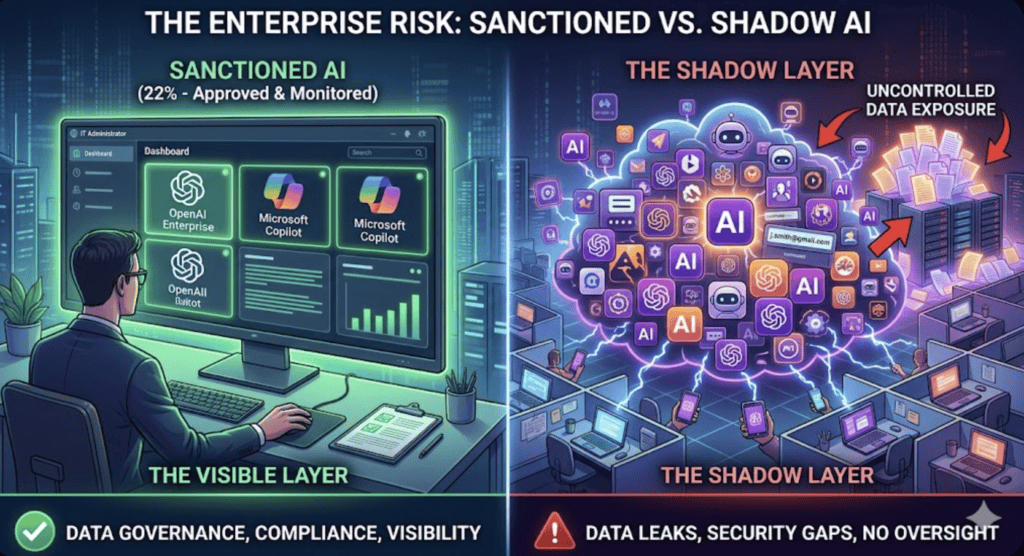
Why Shadow AI is a Growing Enterprise Risk
AI tools are not just software.
They are data processors.
When employees use them freely:
- Sensitive company data may be uploaded
- Customer information may be exposed
- Outputs may not be auditable or compliant
The real issue isn’t usage.
It’s uncontrolled usage.
Common Examples of Shadow AI
Shadow AI shows up in predictable ways:
- Marketing using public AI tools for content generation
- Sales teams using AI for email drafting and prospecting
- Engineers using copilots without governance controls
- HR teams using AI tools for resume screening
Often:
- No logging
- No policy enforcement
- No visibility
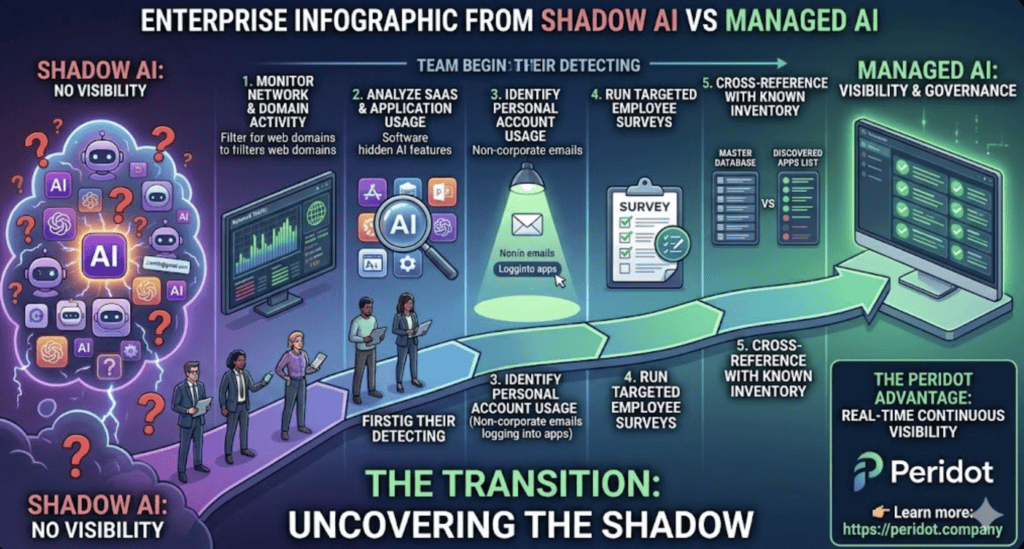
Step-by-Step: How to Detect Shadow AI
1. Monitor Network and Domain Activity
Identify access to known AI platforms:
- OpenAI
- Anthropic
- Google AI services
- Other emerging tools
This gives you a surface-level view of usage.
2. Analyze SaaS and Application Usage
Many AI tools are hidden inside existing platforms. Discover AI tools used in your enterprise.
Check:
- CRM systems
- Marketing automation tools
- Productivity tools
AI is often embedded, not obvious.
3. Identify Personal Account Usage
This is a major blind spot.
Look for:
- Logins outside company-managed accounts
- Use of free tiers
- Non-sanctioned integrations
This is where most shadow AI risk lives.
4. Run Targeted Employee Surveys
Ask directly:
- What AI tools do you use regularly?
- What tasks do you use them for?
- What data do you input?
You’ll uncover tools that don’t show up anywhere else.
5. Cross-Reference with Known Inventory
Compare:
- approved tools
- discovered tools
Everything outside your approved list:
→ is shadow AI
AI Usage & Shadow AI Statistics
- 78% of AI users bring their own tools to work (Cisco)
- 75% of knowledge workers use AI regularly (Microsoft)
- Less than one-third of organizations have formal AI governance (McKinsey)
Shadow AI is not edge behavior.
It is the default.
What We See in Real Enterprise Environments
Across organizations:
- Shadow AI usage is typically 2–5x higher than expected
- IT teams are often unaware of the majority of tools in use
- Most exposure happens through free and unmanaged tools
The biggest misconception:
“We approved a few AI tools, so we’re covered.”
Approval ≠ visibility.
How Shadow AI Connects to AI Audits and Governance
Shadow AI is not a standalone problem.
It connects directly to:
- AI audits across teams
- AI governance frameworks
- Data security and compliance
(If you haven’t audited usage yet, see how to audit AI usage across teams.)
How Peridot Helps
Shadow AI is hard to detect manually—and impossible to track continuously.
Tools like Peridot provide real-time visibility into AI usage across your organization, helping teams identify shadow AI, understand usage patterns, and reduce risk without relying on manual audits.
FAQ
What is shadow AI?
Shadow AI refers to AI tools used without formal approval or oversight within an organization.
Why is shadow AI dangerous?
It can expose sensitive data, create compliance risks, and operate without visibility or control.
How common is shadow AI?
Very common—most organizations underestimate usage significantly.
Can shadow AI be eliminated?
Not entirely. The goal is to detect, monitor, and manage it effectively.
Tools like Peridot are designed to give enterprises real-time visibility into AI usage across teams—without relying on manual audits or surveys.
Instead of guessing, organizations can continuously monitor AI activity, identify risks, and enforce policies from a single system.
Pingback: How to Discover All AI Tools Used Across Your Enterprise - Peridot Blog
Pingback: How to Track AI Tool Usage Across Employees and Departments - Peridot Blog
Pingback: We Analyzed Enterprise AI Usage: What 429 Respondents Revealed - Peridot Blog
Pingback: AI Tool Sprawl: How to Identify and Measure It in Your Organization - Peridot Blog