
Three fundamentally different approaches to mobile app software development exist in 2026. Each one has a legitimate use case, a real cost profile, and a set of failure modes that the people selling each approach would prefer you didn’t know about.
This guide makes the honest comparison — not to recommend one approach over the others, but to give you the information you need to choose the right one for your specific situation.
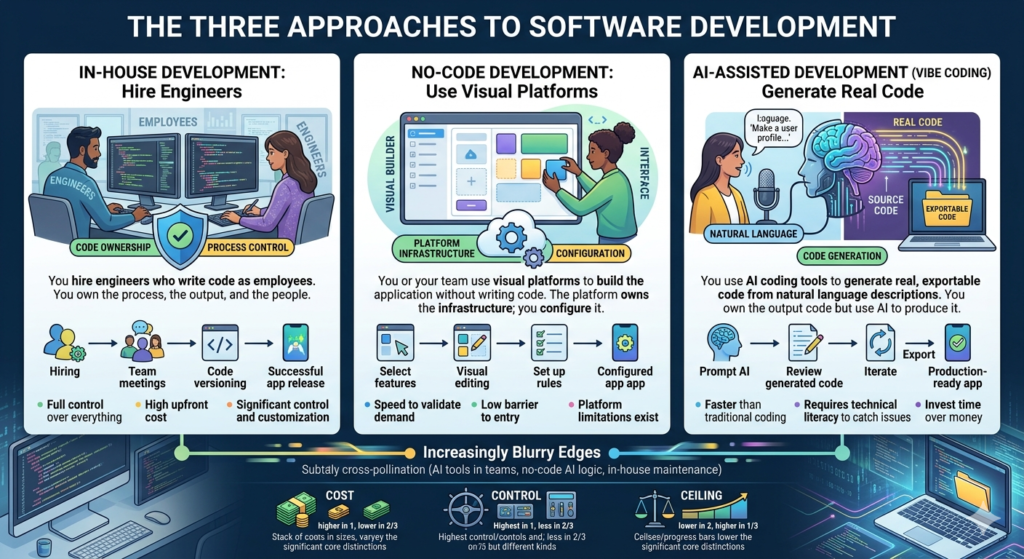
The three approaches
In-house development: You hire engineers who write code as employees. You own the process, the output, and the people.
No-code development: You or your team use visual platforms to build the application without writing code. The platform owns the infrastructure; you configure it.
AI-assisted development (vibe coding): You use AI coding tools to generate real, exportable code from natural language descriptions. You own the output code but use AI to produce it.
These three approaches are increasingly blurry at the edges — in-house teams use AI tools, no-code platforms are adding AI-generated logic, and vibe coding produces code that in-house engineers then maintain. But the core distinctions in cost, control, and ceiling remain significant enough to treat them separately.
In-house mobile app software development
What it actually involves
Building an in-house mobile development capability means recruiting and retaining engineers who write and maintain the application codebase as employees. For mobile specifically, this means iOS engineers (Swift), Android engineers (Kotlin), or cross-platform engineers (Flutter or React Native) — or some combination.
The talent market for mobile engineers in 2026 remains competitive. A senior mobile engineer in the US commands $150,000–$200,000 in total compensation. Flutter and React Native engineers are slightly more available than native iOS/Android specialists, partly because the skill set overlaps with web development.
The honest cost model
Most cost analyses of in-house development stop at salary. The real model:
| Cost component | Annual estimate |
|---|---|
| Senior mobile engineer (1) | $165K–$200K |
| Employer taxes + benefits | $35K–$50K |
| Tooling (IDE, CI/CD, monitoring) | $5K–$15K |
| Infrastructure (servers, CDN, databases) | $10K–$50K |
| Management overhead | $20K–$40K |
| Total, year 1 | $235K–$355K |
This is for one engineer. Most meaningful mobile applications need at least two — one for the mobile application, one for the backend — which doubles the personnel costs.
When in-house development is the right answer
In-house development is right when:
- The application is core to the business — not a tool that supports the business, but the business itself
- The application requires continuous development, not a defined build with periodic updates
- The technical requirements are complex enough that platform constraints would consistently block progress
- The organization is large enough that engineering talent is a standard operating expense, not a startup risk
It is the wrong answer when:
- The product hasn’t been validated with real users
- The application is a support tool rather than the core product
- The organization is at a stage where $300,000 in annual engineering costs would meaningfully constrain other priorities
The talent risk nobody talks about
An in-house mobile development team is a concentration risk. Two or three engineers holding institutional knowledge of a codebase represent a significant dependency. When they leave — and eventually they leave — the time to ramp a replacement is typically 30–90 days of reduced velocity. Plan for this with documentation standards, code review culture, and cross-training from day one.
No-code mobile app software development
What it actually involves
No-code development uses visual platforms — Adalo, Glide, Bubble, AppGyver — to construct mobile application logic through graphical interfaces. No programming language is required. The platform handles infrastructure, deployment, and updates.
The skill required is not zero — understanding data modeling, workflow logic, and UX design still matters. But the barrier to entry is dramatically lower than traditional development, and the time from idea to working product is dramatically shorter.
The honest cost model
| Cost component | Annual estimate |
|---|---|
| Platform subscription | $600–$6,000 |
| Builder time (internal or freelance) | $0–$20,000 |
| Third-party integrations | $1,200–$6,000 |
| Infrastructure (often included in platform) | $0–$2,400 |
| Total, year 1 | $2K–$35K |
The asterisk: this model assumes the application stays within platform capability limits. If you hit the ceiling and need to migrate, migration costs of $20,000–$80,000 are not uncommon for mature no-code applications.
When no-code is the right answer
No-code development is right when:
- Speed to first user matters more than architectural perfection
- The use case maps cleanly to standard application patterns (booking, directory, form, portal)
- The user base will stay below 10,000–15,000 MAU in the planning horizon
- The application is a support tool rather than the core product
- The team needs to validate an idea before committing to a production-grade build
It is the wrong answer when:
- The application requires custom business logic that platforms can’t express
- The user base is expected to exceed platform performance limits within 12 months
- Enterprise customers will ask security architecture questions the platform can’t answer
- The application calls LLM APIs and needs enterprise-grade credential isolation
The security gap in no-code AI applications
This deserves explicit attention because it’s the failure mode that’s growing fastest in 2026.
When a no-code application integrates with an LLM API, the following typically happens:
- The API key is stored in the platform’s credential vault — shared infrastructure
- All LLM calls route through the platform’s servers
- There is no per-customer data isolation
- There is no audit trail of what data was sent to which model
- Data residency is determined by the platform’s infrastructure, not yours
For B2C applications with non-sensitive data, this is fine. For any application touching enterprise data, this architecture creates sales-blocking security concerns. The platform tells you it’s secure. Enterprise IT teams ask different questions than the ones the platform answers.
AI-assisted (vibe coding) mobile app software development
What it actually involves
Enterprise Vibe coding uses AI development tools — Peridot, Cursor, Claude Code — to generate application code from natural language descriptions and iterative prompting. The output is real source code — typically React Native, Flutter, or a web framework — that you own, can inspect, and can deploy on your own infrastructure.
The process: you describe a feature or screen in plain language. The AI writes the code. You review it, test it, and iterate. The cycle continues until the application does what you want.
The honest cost model
| Cost component | Annual estimate |
|---|---|
| AI tooling subscriptions | $500–$2,400 |
| Infrastructure (hosting, database, CDN) | $600–$6,000 |
| Occasional developer review (optional) | $0–$15,000 |
| Security audit (strongly recommended) | $2,000–$10,000 |
| Total, year 1 | $3K–$33K |
This model assumes the founder or a team member with technical literacy is doing the building. For teams with no technical background, vibe coding has a higher learning curve than no-code platforms.
When vibe coding is the right answer
AI-assisted development is right when:
- You want to own the code without building a traditional engineering function
- The application is AI-native and calls LLM APIs
- You’ve validated a concept with no-code and want to rebuild on infrastructure you control
- Your user base or security requirements will eventually exceed no-code platform limits
- You’re building something where the exit cost of platform lock-in is unacceptable
It is not the right answer when:
- The team has no technical literacy and isn’t willing to develop it
- The application requires deep device hardware integration that requires native platform expertise
- The timeline requires production-quality code in days rather than weeks
The security requirement for vibe-coded AI applications
Vibe coding solves the lock-in problem. It doesn’t automatically solve the security problem.
AI-generated code tends to have predictable security gaps: API credentials handled insecurely, missing input validation, insufficient rate limiting, and — most critically for AI applications — no default architecture for data isolation between customers.
For vibe-coded applications that call LLM APIs and target enterprise customers, the security architecture needs to be a deliberate design decision, not something bolted on after the first enterprise prospect asks about it. Peridot provides the secure deployment for this use case — VPC boundaries, isolated credentials, audit trails — that makes enterprise deals possible without rebuilding the application from scratch. The conversation about it belongs at the start of the build, not six months in.
The direct comparison
| Dimension | In-house | No-code | Vibe coding |
|---|---|---|---|
| Time to first working product | 3–6 months | Days to weeks | Days to weeks |
| Year 1 cost | $235K–$355K | $2K–$35K | $3K–$33K |
| Code ownership | Full | None | Full |
| Scalability ceiling | None (by design) | 10K–50K MAU | None (by design) |
| Exit cost | Low | High | Zero |
| Enterprise security readiness | High (with investment) | Low | Medium (requires deliberate work) |
| AI integration quality | Excellent | Limited | Native |
| Right stage | Post-PMF, scaling | Pre-PMF, validation | Pre-PMF to scaling |
The hybrid model that most teams end up with
In practice, most successful mobile applications in 2026 use a combination:
Early stage: No-code or vibe coding for validation. Fast, cheap, reversible.
Post-validation: Vibe coding for the production rebuild. Own the code, remove the platform ceiling.
Enterprise customers: Add security architecture (Peridot or equivalent) to the vibe-coded application. Don’t rebuild — add the layer.
Scale: Add in-house engineers to own and extend the codebase. Don’t replace the vibe-coded foundation — build on it.
This progression isn’t mandatory, but it represents how the cost and risk profiles of each approach complement each other across the product lifecycle. The mistake is treating each approach as mutually exclusive rather than as sequential stages in a product’s maturity.
Also read
How to Develop an Enterprise Mobile Application in 2026 with Vibe Coding: The Honest Guide
Develop a Enterprise Mobile App Without an Agency: 7 Paths and Their Real Costs
The 8 Best Mobile App Development Platforms for Non-Engineers
How to Choose an Enterprise App Development Platform: The Decision Framework
Mobile App Software Development: In-House vs No-Code vs AI-Assisted
Best Mobile App Creation Software for Solo Founders in 2026
Mobile App Building Software: What the Benchmarks Actually Show